By Sulaiman Tasleem
The first day of the conference began with Lecture One delivered by Maulvi Khalilur Rahman Nasir. He traced the historical development of fiqh, highlighting its early foundations and the later period of decline when many abandoned the Qur’an and Hadith for blind adherence to scholars, sometimes leading to takfir over differences. He established the need for a just arbiter, identifying this role in the Promised Messiah, and presented practical examples of the reformative impact of his jurisprudence.
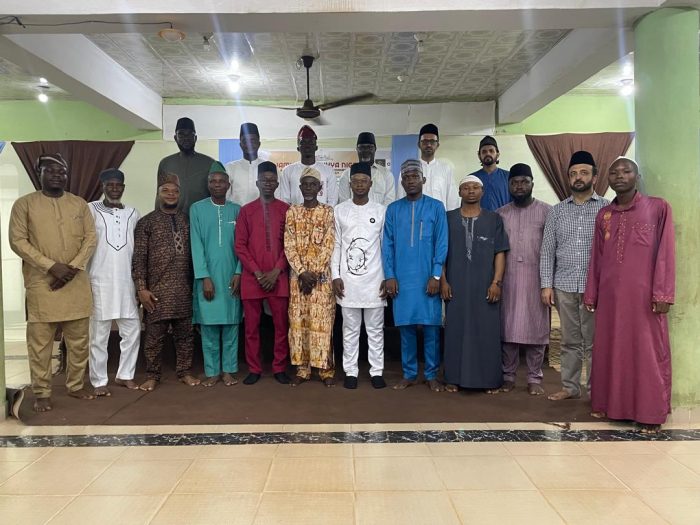
The session was chaired by Alhaji Abdul Hameed Abdul Azeez, an elderly missionary of the Jama’at. The event was attended by missionaries, members of the Jama’at, and other dignitaries.
This was followed by an interactive session moderated by Maulvi Atoki Abdur Razaq. The panelists—Maulvi Nurullah Lamina, Maulvi T. O. Shoboyede, and Maulvi Yusuf Abdul Khaliq—all scholars of the Jama’at, discussed the theme: “Reforming Islam in Nigeria: The Revolutionary Impact of the Promised Messiah’s Jama’at on the Religious Landscape.”
The discussion examined the need for reform in the Muslim world using jurisprudential differences as a case study, and the negative impact of certain innovations in Nigeria prior to Ahmadiyya. The role of sound religious education in curbing extremism was also emphasized.
A comparative analysis of practices before and after the Ahmadiyya era was presented, including the use of the Qur’an, Janazah rites, Laylatul Qadr, fasting for children, Zakatul Fitr, Islamiyya education, and issues of extremism such as takfir and violent ideologies.
The session ended with a question-and-answer segment involving students.
In the evening, a quiz competition on the life of Hazrat Mirza Ghulam Ahmad (as) was held. Each class presented four representatives, and the questions were based on “Life of Ahmad” by A.R. Dard.
We continue the program today, Day two, where Respected Missionary in Charge and many other dignitaries are expected to grace the program.
No comment